
How to Sound Better Rapping: Voice, Breath and Delivery

Almost nobody likes their own voice the first time they hear it on a recording, and that reaction hides a real problem: what you hear in your head is not what the microphone hears. Learning how to sound better rapping is not about a new microphone or another plugin, it is about breath, distance, timing and the small habits that decide whether a take is usable. Most rappers who sound bad on record are not bad rappers, they are recording badly.
Why you sound worse on record than in your head
Two things happen the moment you press record. Your skull stops helping: at home, bone conduction carries your voice to your ears, so you hear a fuller, lower version of yourself, while the microphone only gets what leaves your mouth. And you hear everything at once instead of choosing, so a swallowed consonant becomes the whole picture.
The gap closes with habits, not gear: a phone in a quiet room can carry a rap vocal, a great microphone next to a humming fridge cannot.
1. Breathe low and plan the breaths
A gasp in the middle of a bar is the fastest way to sound like an amateur, and a line that dies on its last word means the tank was empty two syllables earlier. Breathe into the stomach, not the shoulders, and take the air before the bar that needs it.
Then mark the breaths on the paper. A planned breath is part of the performance, a surprise breath is noise. If a verse has no room to breathe, split it; that is not cheating.
2. Control the distance to the microphone
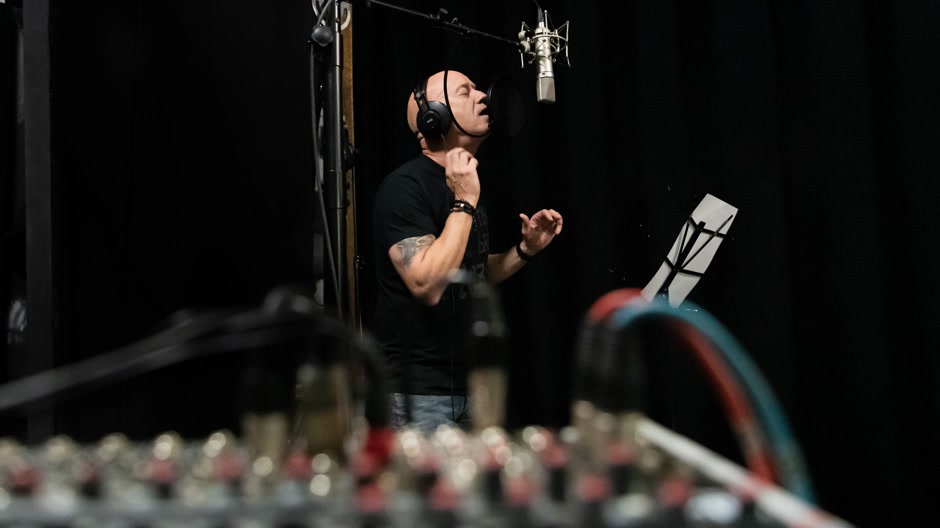
Close to the capsule you get weight and low end; too close you get plosives, a boomy tone and every lip smack. A hand span is the usual start, with a pop filter in between and the microphone slightly above or below the mouth, so the air passes beside it.
Move back on the loud line and in on the quiet one. Ride the distance the way you ride the beat: that keeps a shout from clipping and a whisper from vanishing.
3. Find the pocket before you find the speed
Rapping over a beat and rapping inside it are different jobs. The pocket is the small space where the words land with the drums, and it exists at every tempo. Fast flows and triplets sit on top of that pocket; without it, they sound like an argument with the instrumental.
Practise the verse with the drums alone, then bring the melody back. If the words stop fitting, the problem is the writing, and how to rap on beat goes through the counting. A simple flow that lands beats a clever flow that drifts.
4. Say the line, then rap it
Before you record, read the bar out loud as if you were explaining it to someone across a table. You will hear the words you are faking: a rhyme that only works on paper, a phrase with no stress. Then keep that weight when the beat comes in, so the take sounds like a person who means it.
5. Cut three clean takes, not fifteen tired ones
Voices flatten with use: the pitch narrows, the consonants soften and the energy drops without getting quieter. Three focused takes with a warm voice beat fifteen exhausted ones, and keeping the first good one is not lazy. Stop when the last line lands the same as the first.
Keep the setup simple while you perform: one track, headphones, no reverb in your ears, because reverb hides pitch and timing mistakes now and exposes them tomorrow. Save the tone for the mix; if the vocal still sounds wrong there, how to mix vocals over a beat starts from the take.
6. Pick a beat that leaves room for the voice
Half of the bad voice problem is a busy instrumental. When the top line never rests and the drums fill every gap, the ear has nothing to separate and the vocal fights a synth for the same space. The quieter the beat, the less you have to push.
Lullaby is a smooth trap beat with a soft melodic edge, steady 808s and crisp drums, written for reflective verses and a hook that stays in the head: room to breathe, and a low end that does not fight the voice.

It sits in the trap instrumentals; more options with space in the mix are in the instrumental catalogue.
The six checks before you hit record
None of this takes talent, only a routine:
- Water at room temperature, never ice, and no shouting for an hour before.
- Breaths marked on the lyrics, one per two bars at most.
- A hand span from the mic, with the pop filter on.
- The verse practised with the drums alone until it lands.
- Two or three takes with the same energy, then stop.
- The best take bounced and heard on a phone speaker before you judge it.
A phone speaker is the honest test: if the words are clear there, they survive anywhere.
FAQ
Can I sound good rapping with a phone microphone?
Yes, if the room is quiet and you stay close without clipping. A phone records a narrow band, so placement matters more than on a condenser: a hand span, soft consonants, no fan in the room.
Should I rap louder or softer?
Neither, you should rap with the same pressure you would use across a table, and let the microphone do the work. Shouting flattens the tone and picks up the room; whispering disappears in the mix.
Why does my voice sound nasal on record?
Usually because the jaw and tongue are tense and the air escapes through the nose. Open the mouth more on the vowels, lower the shoulders and record standing up. A high-pass filter in the mix hides part of it, never all.
How long does it take to sound better rapping?
One session if you fix breathing and distance; a few weeks of takes if you are also changing the delivery. Record weekly and compare a month apart, not day to day.


