
How to Start Rapping: Pick a Beat and Write 8 Bars
Learning how to start rapping is less about talent than about order: one beat, eight bars, one take, repeated until it sounds like you. Most beginners skip that order, download twenty instrumentals and never finish a verse, because a full song is the wrong first target.
You do not need a studio, a name or a producer. You need a beat you can follow, a phone that records and a routine you can keep for a month.
Choose a beat before you write anything
Pick one instrumental and stay with it for the whole session. A beat with a clear kick and snare tells you where every bar starts, and that is the only map a beginner needs. Busy beats with a hundred sounds hide the map.
Test it before you commit: play the beat and nod. If you can find the same cycle four times in a row without thinking, the beat is right for you. If you keep losing the one, it is not a hard beat, it is the wrong beat for now.
The instrumental catalogue is organised by style and every card plays before you commit, so you can test five beats in five minutes.
Write eight bars, not a song
A verse is sixteen bars, and a first verse should be eight. Eight bars is short enough to hold in your head without a phone and long enough to prove that you can stay on the beat.
- Loop the first eight bars of the beat and leave it running.
- Write one short line per bar, four to eight syllables, and nothing longer.
- End most lines with a word that rhymes with the line after it.
- Say the lines with the beat, never against it.
- Cut anything you cannot say twice in a row without tripping over it.
Two good lines beat eight clever ones you cannot deliver. If a bar makes you stumble, the bar is the problem, not your voice.
Make the words sit on the drums
Rapping on beat means your stressed syllables land near the kick and the snare. It does not mean shouting every word. Start by placing the last word of each line on the snare, then push the sentence a little earlier or later until it feels natural.
If you lose your place halfway, the problem is usually the count and not the flow. Counting four beats per bar fixes it in ten minutes, and this guide explains it: how to count bars in rap.
Record yourself on the phone and listen back the same day. What feels fast in your head usually sounds slow on the recording, and the gap between the two is exactly what practice closes.
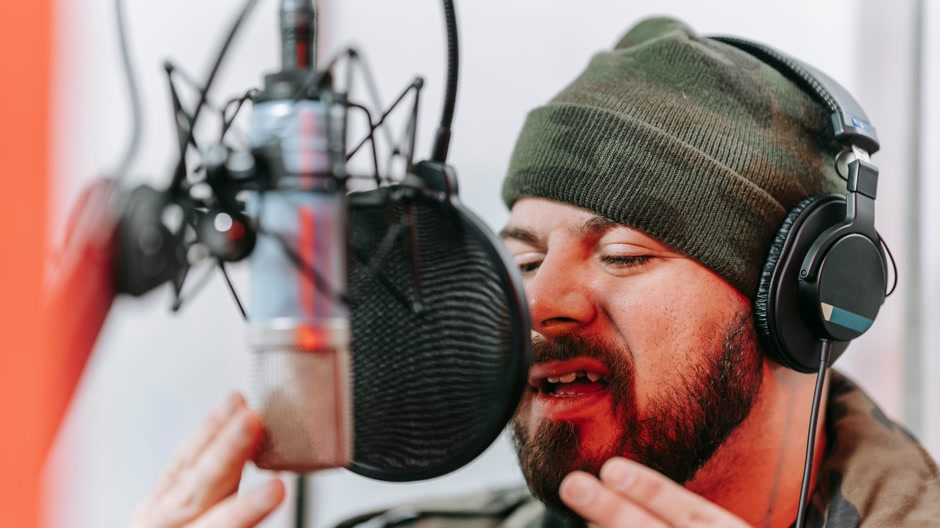
Record a first take with what you already have
A phone in a room with a sofa, a bed and curtains is enough for the first month. Avoid the bathroom and the kitchen: a bright, empty room adds echoes that no amount of mixing removes later.
Record the whole eight bars in one run, mistakes included. A take with one weak line teaches you more than ten fragments, because you hear where the energy drops and which line you rush. Keep the best full take and delete the rest.
A first month of practice
The plan is deliberately small. It works because you repeat it, not because it is clever.
- Days 1 to 7: eight bars on one beat, every day, out loud.
- Days 8 to 14: a second eight bars on the same beat, then join both halves.
- Days 15 to 21: record the full sixteen and listen once, with a pen in hand.
- Days 22 to 30: one new beat, same process, and this time faster.
Twenty minutes a day beats three hours on a Sunday. Frequency builds the voice faster than long sessions, and the days you do not feel like it are the ones that count.
Start on a beat with room to breathe
Midnight Oil is a 90s rap instrumental with a drum pattern you can follow without counting, which is what a first verse needs: space between the hits and a loop that repeats exactly.

The old school instrumentals follow the same logic: clear kick, clear snare, and nothing competing with the voice.
FAQ
Do I need a microphone to start rapping?
No. A phone records well enough to hear timing, tone and mistakes. Buy a microphone when the phone is the thing holding the take back, not before.
How long does it take to get good at rapping?
Months, not weeks, and the curve is uneven. Most people quit in week three, when the first excitement fades and the routine has not become a habit yet.
Should I write my own lyrics or use a ghostwriter?
Write your own. A ghostwritten verse teaches you nothing about your own voice, and the first hundred bars are supposed to be bad.
Can I start rapping over free beats?
Yes, as long as the licence allows it. Free downloads often cover practice only, so check the terms before you release anything and keep the licence.


