
Kirby's Dream Land Music on the Game Boy: Composers and Themes

Kirby's Dream Land music had to fit inside one of the smallest sound chips Nintendo ever shipped: four channels, no samples, no reverb, and a melody that had to stick in eight bars. That pressure is exactly why the soundtrack still gets ripped, covered and sampled, and why so much chiptune production sounds the way it does today.
How the Game Boy squeezed a soundtrack into four channels
The Game Boy carries an audio processing unit that behaves like a programmable sound generator, not a sampler. Everything you hear comes from four voices running at once, and the composer decides what each one does before the cartridge is ever burned.
- Pulse one: a square wave with frequency and volume movement. This is where the lead line lives, and where most Kirby themes are won or lost.
- Pulse two: a second square wave with volume control only, so no vibrato tricks. It carries harmony, counter melodies and the arpeggios that fake a chord.
- Wave: a channel that plays any waveform stored in RAM, which is how the bass got a softer, almost reed like tone.
- Noise: white noise with volume changes, the source of every hi hat, snare and crash on the console.
Four voices, no spare hands. There is no room for a pad or a doubled hook, so the writing has to be melodic by necessity, and the percussion has to be part of the arrangement instead of a layer on top of it. The internal speaker is monaural, with stereo available through the headphone jack, which is why so many people remember these tunes from a pair of cheap earbuds on a school bus.
Kirby's Dream Land (1992): Jun Ishikawa and the theme everyone knows
The first game in the series was developed by HAL Laboratory and published by Nintendo for the Game Boy in 1992, and it was the debut project of designer Masahiro Sakurai. He wanted something a beginner could pick up in a minute, with optional challenges underneath for players who wanted them. The soundtrack duties went to Jun Ishikawa, who would end up defining how the series sounds.
The theme most people can hum without thinking is Green Greens, the music of the first stage, which sets the tone for everything the series did afterwards: bright lead, bouncing bass, drums that keep the pulse moving. Listening back to the whole cartridge is still the fastest way to hear what the hardware could do in the right hands.
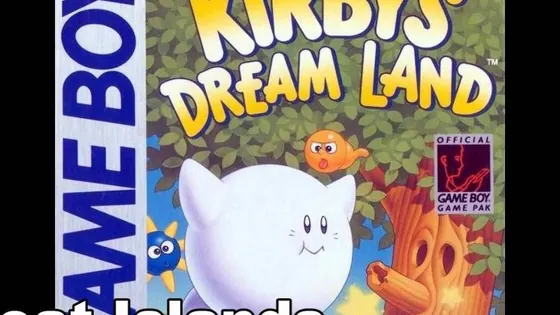
The game sold 5,130,000 copies and stayed the best selling entry in the series for three decades, until Kirby and the Forgotten Land finally passed it. A soundtrack that people still search for by name is a big part of that reach.
Kirby's Dream Land 2 (1995): Hirokazu Ando and the animal friends
The sequel arrived in 1995, also on the Game Boy, with three animal friends joining Kirby and a soundtrack credited to Hirokazu Ando and Tadashi Ikegami. Ando is the other pillar of Kirby music, and he also wrote the music for Super Smash Bros. on the Nintendo 64 and its sequel.
Dream Land 2 also supports the Super Game Boy, the adapter that let Game Boy cartridges run on a Super Nintendo, and it uses that extra hardware for a custom color scheme, a border and a handful of new sound effects. The same tunes, dressed differently, which is a neat summary of how this era of game music was treated: the melody was the product, the presentation was negotiable.
The Dream Land music that came after the Game Boy
The themes did not stay on the handheld. Kirby's Adventure for the NES arrived in 1993 with Hirokazu Ando on music, and Kirby's Dream Land 3 for the Super Nintendo followed in 1997 with Jun Ishikawa back at the desk. Then the series looped around itself: Kirby: Nightmare in Dream Land, the Game Boy Advance remake of Kirby's Adventure, shipped in 2002 with Ishikawa and Ando sharing the credits.
Ishikawa left HAL Laboratory in 2023 and continues to write for Kirby games, which says as much about the sound he built as any sales figure does.
The instrumentals those themes inspired
That music is the reason a few of the instrumentals in this catalogue exist. Nightmare in Dreamland, named after the Game Boy Advance remake, takes the bright lead and the skittering drums and rebuilds them with modern low end, so it can sit behind a full verse instead of a level screen.
Dream Land, whose style is literally Kirby's Dream Land, borrows the 8 bit bounce and the arcade brightness. Retrolife takes the same nostalgia in a hyperpop direction, with the plucks pushed forward. You can hear them side by side here: Nightmare in Dreamland, Dream Land and Retrolife, plus a fourth one simply called Kirby.
If that lane is what you are after, the chiptune instrumentals and the videogame beats collect the rest of it in one place, and everything is available to lease or buy in the catalogue.
Kirby's Dream Land music: FAQ
Who composed the Kirby's Dream Land soundtrack?
Jun Ishikawa wrote the music for the 1992 Game Boy game, and he is the composer most associated with the series. Hirokazu Ando, his counterpart at HAL Laboratory, handled Kirby's Dream Land 2 in 1995 alongside Tadashi Ikegami, and the two of them share the credits on plenty of Kirby games, including the 2002 Game Boy Advance remake.
What is the most famous Kirby theme?
Green Greens, the first stage of Kirby's Dream Land, is the one most listeners know even if they never played the cartridge. It has been rearranged in later Kirby games, in the 30th anniversary concert and in fan covers, which is why the phrase "kirby dream land song" still pulls searches three decades later.
Why does Game Boy music sound like chiptune?
Because chiptune is what happens when a composer writes inside the same limits the hardware imposed: square wave leads, a wave channel for bass and noise for percussion. Modern chiptune instrumentals imitate that palette on purpose, sometimes down to the arpeggios and the limited polyphony.
Which Kirby games came out on the Game Boy?
The two mainline entries are Kirby's Dream Land (1992) and Kirby's Dream Land 2 (1995), both released on the original Game Boy and both playable on later Game Boy Color and Game Boy Advance hardware. The series then moved to the NES, the Super Nintendo and the Game Boy Advance, where Nightmare in Dream Land revisited the second console era with new arrangements.


